
Be Promotable; How to Increase the Value of Your Business Analyst Qualifications
How do you think about your professional development? When you hear the term, does your mind shift to training courses, webinars and reading books? How about the project work you do and the “extra” tasks you take on?
Whether you are looking for a job, seeking a promotion, or just want to make sure that your investments in professional development are keeping you up with your business analyst peers, it’s important not to focus just on training, certifications, or specific experiences. Managers in a position to hire or promote you want to know that you can perform at the level expected for the position you are seeking. They want to know that you’ll be an effective contributor. They are looking for an indicator of successful future performance.
One way to frame yourself as a successful future performer is to focus on what I consider marketable qualifications. Consider the following formula.
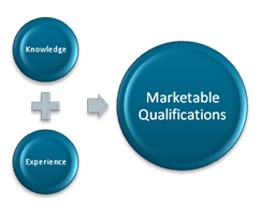
Think about what this means. A marketable qualification is formed by knowledge of how to do something and the experience gained from actually doing it. If I’m a manager and I’m considering you for an open position or a promotion, I’m not going to be so concerned about what you know. I’m going to be most concerned about your experience. The flip side of this equation is that you may have lots of valuable experience, but little or no formal knowledge. This often happens when you use your instincts to deliver successfully. If you have the experience but not the knowledge, you might overlook marketable qualifications because you simply don’t know the value of the experience you have. This is why marketable qualifications are created by both knowledge and experience.

As you think about your professional development, it pays to consider both parts of the marketable qualification equation. Look for opportunities to build your knowledge base and your experience and seek to keep these two aspects in sync for the best indicators of top performance.
What follows are some general rules of thumb for using the concept of a marketable qualification in thinking through your professional development strategy.
1. Focus on knowledge acquisition where you’ll also have the opportunity to build relevant experience.

I meet a lot of potential business analysts that have invested countless hours and lots of money in formal training programs and educational certificates. Oftentimes these individuals have spent a scant amount of time in the workplace and have little experience facilitating meetings, defining project scope, or analyzing and specifying requirements. They have a lot of book knowledge about business analyst techniques but no experience applying them in a real-world setting. No experience, no marketable qualifications.
The same holds true for mid- and senior-level business analysts within an organization. If you’ve read lots of books on agile but never used agile practices, your book smart not street smart. The first time you find yourself on an agile project or create the opportunity to apply an agile practice to a more traditional project, you’ll really learn what it takes to be an agile business analyst.
As you look at training options, even employer-sponsored ones, really focus on where you can learn and then apply your learning the day or the week you learn it. What chapter of a book could you read tonight and apply tomorrow? What archived webinar could you attend over your lunch break and use this afternoon? Immediate application of newly acquired knowledge means you are more likely to build valuable marketable qualifications. If you don’t apply what you learned, that learning will not really sink in. You might develop a slightly broader perspective on how you might use the skill, but without practice you don’t know if you can actually use the skill. If you are talking to a hiring manager, they are going to want to hear about your experience exercising your skills, not what you learned from a book or a training class.
2. Don’t overlook your project experience as opportunities to expand your marketable competencies.
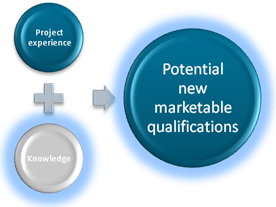
One common challenge business analysts face, especially in our current economic environment, is that there is little funding for “professional development”. And by professional development here we typically mean training opportunities, conferences, and other high-cost learning opportunities. If we are employed or able to volunteer our time, there are typically ample opportunities to develop professionally through the work we do day-to-day. But to take advantage of these opportunities requires some forethought.
The easiest place to start is to look at each project assignment for opportunities to increase your qualifications. Is there a pain point that needs to be addressed? Is there an especially challenging stakeholder to deal with? Are there non-technical subject matter experts? Project anomalies of any kind provide opportunities for you to experiment with a new technique. Anything that is different this time around or in which your team struggled the last time around, are ripe opportunities for you to try something new to achieve results.
By framing these new career experiences within the pain points of your project team or organization, you are also ensuring that your efforts better align with your manager’s expectations. It’s very difficult for a manager to condemn you for doing something “outside-the-box” when you are trying to address a new problem or fix an old one. It’s much more difficult for your manager to support you if you apply a technique simply for “the experience”. Projects provide opportunities to build qualifications. Find them and take them. (And revisit point 1 to seek out relevant learning opportunities as you find them.)
3. Back-up your prior experience with the formal learning
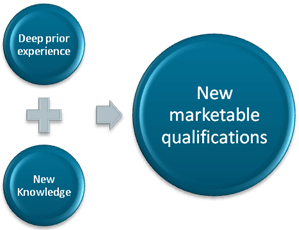
For many senior business analysts our experience supersedes our knowledge. This also often happens to experienced professionals who find the business analyst profession after having worked for several years in a variety of related roles. Having the experience without the knowledge base will make it difficult for you to appropriately frame that experience as a marketable job qualification.
As a senior business analyst we might have experience performing very senior-level tasks, such as developing a business case to secure approval for a project, but never had any formal education about what should be in a business case and how it should be used. In this situation, some formal knowledge acquisition, coupled with previous work experience, can develop a marketable qualification. Education provides you with the confidence to use the right terminology and explain experiences you’ve already had in the formal terms used within the profession or your industry. Many business analysts I have interviewed report that CBAP study groups or reading the BABOK help them solidify their prior experience.
As you look back through your career history and your key projects, what have you naturally done well? What resources could you leverage to solidify that experience into a formal marketable qualification? How do other professionals talk about that kind of experience? What qualifications in job postings require that experience?
Finding and validating our marketable qualifications is no simple task. It requires introspection, honesty, objectivity, and a healthy dose of realism. The path to accumulate new qualifications is often no easier as we set out to balance our knowledge acquisition with our new experiences. But on the other side of this journey lies the ability to build career experiences in ways that line you up for career advancement, new jobs, promotions, and leadership positions. Is it worth it to you?
Don’t forget to leave your comments below
Laura Brandenburg hosts Bridging the Gap and is the author How to Start a Business Analyst Career and of the forthcoming eBook The Promotable Business Analyst, a guide book for crafting a fulfilling and successful career as a business analyst. To receive a special offer when The Promotable Business Analyst is available, sign-up for our early bird list.